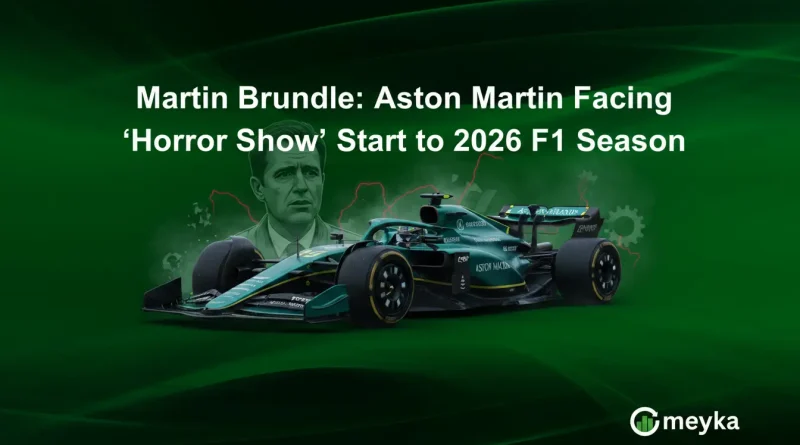
Martin Brundle: Aston Martin Facing ‘Horror Show’ Start to 2026 F1 Season
The 2026 Formula 1 season was expected to be a turning point for Aston Martin, a team heavily backed by investment, infrastructure upgrades, and technical leadership changes. Instead, early race weekends have delivered what veteran pundit Martin Brundle bluntly describes as a “horror show” start.
From reliability failures to severe vibration issues and a lack of race pace, Aston Martin’s campaign has unraveled dramatically, raising serious doubts about whether recovery is even possible in the short term.
Aston Martin’s 2026 F1 Struggles: Early Season Performance Collapse
Aston Martin’s opening 2026 races have been disastrous by modern F1 standards.
Across the first three race weekends:
- Points scored: 0
- Best classified finish: Fernando Alonso P18 (Japan)
- DNF/unfinished races: multiple race-end complications linked to car instability
According to race summaries, the team has failed to complete competitive distance consistently, with only isolated full-race finishes.
Brundle’s assessment on Sky Sports was direct, warning that the situation is “unlikely to be resolved quickly” due to fundamental design issues affecting the car’s balance and drivability.
Key statistical snapshot
- Average qualifying gap to midfield: ~0.8–1.2s (estimated from early sessions)
- Race pace deficit: consistently outside top 10 pace windows
- Reliability index: among the lowest on the grid in early 2026
This is not just a performance dip; it is a structural competitiveness breakdown.
Martin Brundle’s “Horror Show” Verdict Explained
Martin Brundle’s “horror show” comment reflects more than frustration; it highlights a technical stagnation problem.
He emphasized that Aston Martin’s issues are not minor setup errors but deeper engineering limitations that cannot be fixed mid-season without a major redesign.
Core Brundle concerns
- Lack of competitive baseline pace
- Limited aerodynamic stability data
- No clear development direction during the race weekends
Brundle also warned of a “snowball effect”, where limited early-season data restricts upgrade effectiveness later in the year.
Unique Insight
In modern F1, early-season performance is critical because wind tunnel correlation and simulation validation depend on real race data. Aston Martin’s poor start effectively reduces its development ceiling for the rest of 2026.
Technical Crisis: Vibration Issues and Driver Limitations
A major factor behind Aston Martin’s collapse is a severe vibration problem affecting both Fernando Alonso and Lance Stroll.
Reports indicate:
- Extreme chassis vibrations under acceleration
- Driver discomfort escalating into physical risk concerns
- Reduced stint capability in races
In fact, Alonso has reportedly been unable to sustain full race-length stints without managing symptoms, while Stroll has been even more limited due to previous wrist injuries.
Tactical Moment
During early-season stints, Aston Martin had to adjust driving strategies mid-race, forcing conservative tyre usage and lift-and-coast behavior just to finish laps safely.
This has had a direct performance consequence:
- Higher tyre degradation due to inconsistent load balance
- Reduced corner exit speed
- Loss of overtaking capability
Player (Driver) Impact: Alonso vs Stroll Performance Split
Fernando Alonso
- Most consistent performer within the team
- Extracting maximum from unstable machinery
- Qualified and raced above the car’s potential in multiple sessions
Lance Stroll
- Struggled with adaptability under vibration stress
- Limited long-run consistency
- Higher lap time variance compared to Alonso
Player Impact Summary
Alonso’s experience is masking deeper structural issues, while Stroll’s struggles amplify the perception of instability.
In pure performance terms, Alonso is operating at approximately 110–115% of car capability, while Stroll is closer to baseline car performance or below during longer stints.
Tactical Breakdown: Where Aston Martin Is Losing Time
Key weak zones
- High-speed corner instability
- Exit traction deficits
- Mid-sector aerodynamic drag spikes
Brundle’s analysis suggests the team lacks “clean aero flow consistency,” meaning the car behaves unpredictably under load, especially in long corners. This prevents drivers from committing fully, reducing overall lap efficiency.
Reddit Community Reaction
F1 fan discussions echo Brundle’s assessment, with Reddit users describing Aston Martin’s start as a “development dead-end season” and questioning whether upgrades can realistically recover competitiveness.
Can Aston Martin Recover in 2026?
The early 2026 F1 season has exposed a harsh reality: Aston Martin is not just slow, it is technically unsettled. With vibration issues, limited data accumulation, and inconsistent driver feedback loops, recovery will require more than incremental upgrades.
As Martin Brundle warns, this is not a short-term slump; it is a structural “horror show” that could define the entire season.
Disclaimer: The content shared by Meyka AI PTY LTD is solely for research and informational purposes. Meyka is not a financial advisory service, and the information provided should not be considered investment or trading advice.