
Wild vs Avalanche: Colorado Hosts Game 1 of Western Conference 2nd Round
The wild vs avalanche playoff matchup begins with two teams arriving in strong form, but with very different paths behind them. Colorado enters Game 1 rested, confident, and carrying the league’s best regular-season record, while Minnesota arrives battle-tested after surviving a tough first-round series against Dallas. This Western Conference second-round clash feels heavier than a normal playoff matchup because both teams bring elite speed, high-end skill, and defensive identity into the series.
Game 1 at Ball Arena is more than just an opener. It is the first real test of styles. Colorado wants pace, speed, and open ice. Minnesota wants structure, physical pressure, and defensive disruption. The outcome of this opening game could shape the rhythm of the whole series. That is why the focus stays on goaltending, special teams, and momentum control before the puck even drops.
Wild vs Avalanche playoff journey brings two different stories into Game 1
Colorado reached the second round in dominant style. They swept the Los Angeles Kings in four games and looked balanced on both ends of the ice. Their offense remained explosive, but their defensive discipline stood out even more. The Avalanche allowed very little space in the neutral zone and stayed sharp in transition. That complete structure is why they enter this series as one of the strongest Stanley Cup contenders.
Minnesota took the harder road. They defeated Dallas in six games and earned their first playoff series win since the 2014-15 season. That win gave the Wild confidence, but it also took energy. Unlike Colorado, Minnesota has had less rest and enters this series dealing with injuries to key players. Still, their ability to fight through pressure against Dallas gives them emotional momentum heading into Denver.
Regular-season record numbers show close competition
The Avalanche finished the regular season at 55-16-11 with 121 points, the best mark in the Western Conference. Their offense was the most productive in the NHL, scoring 298 goals. Their defense remained equally reliable, allowing only 197 goals.
Minnesota finished at 46-24-12 with 104 points. Their offensive production stayed strong at 268 goals, while their defensive game improved late in the season. The season series between these teams finished evenly, with both teams posting 2-1-1 records against each other. That tells us this matchup is much tighter than standings alone suggest.
Colorado’s edge comes from consistency. Minnesota’s edge comes from battle-tested resilience.
Game tempo and ice control will decide the opener
Game tempo may become the biggest story in this wild vs avalanche matchup. Colorado thrives in speed. Nathan MacKinnon leads one of the fastest transition attacks in hockey, and when the Avalanche control pace, they force teams into mistakes. Their ability to enter the offensive zone cleanly creates constant pressure.
Minnesota prefers controlled hockey. They want tighter neutral-zone play and stronger board battles. Against Dallas, they slowed the pace and forced mistakes through pressure. If they repeat that formula, they can limit Colorado’s offensive rhythm.
This battle is simple. If Colorado controls tempo, they gain the advantage. If Minnesota controls the pace, the game becomes uncomfortable for the Avalanche.
Special teams often decide playoff openers because nerves are high and mistakes are common. Colorado’s power play remains dangerous because of Makar’s movement and MacKinnon’s shooting threat. Even when they do not score, they create pressure that changes momentum.
Minnesota’s penalty kill will be tested immediately. They survived difficult penalty situations against Dallas, but Colorado’s power play has more speed and more shooting options.
On the other side, Minnesota’s power play relies on Kirill Kaprizov’s creativity and Matt Boldy’s finishing ability. Colorado’s penalty kill has looked strong in the playoffs, and Scott Wedgewood has been excellent behind it.
This special teams battle may decide the emotional flow of Game 1.
Goalie matchup brings calm vs experience
Goaltending remains one of the most important parts of this series. Jesper Wallstedt has become a major playoff story for Minnesota. The young goalie posted a 2.05 goals against average and a .924 save percentage in the first round. His calm style helped stabilize the Wild during pressure moments.
Colorado’s Scott Wedgewood has also been outstanding. He went 4-0 against Los Angeles with a 1.21 goals against average and a .950 save percentage. His positioning and rebound control gave Colorado confidence.
This matchup is fascinating because both goalies enter in form. Wallstedt represents young confidence. Wedgewood represents playoff composure. The better goalie in Game 1 may shape the whole series.
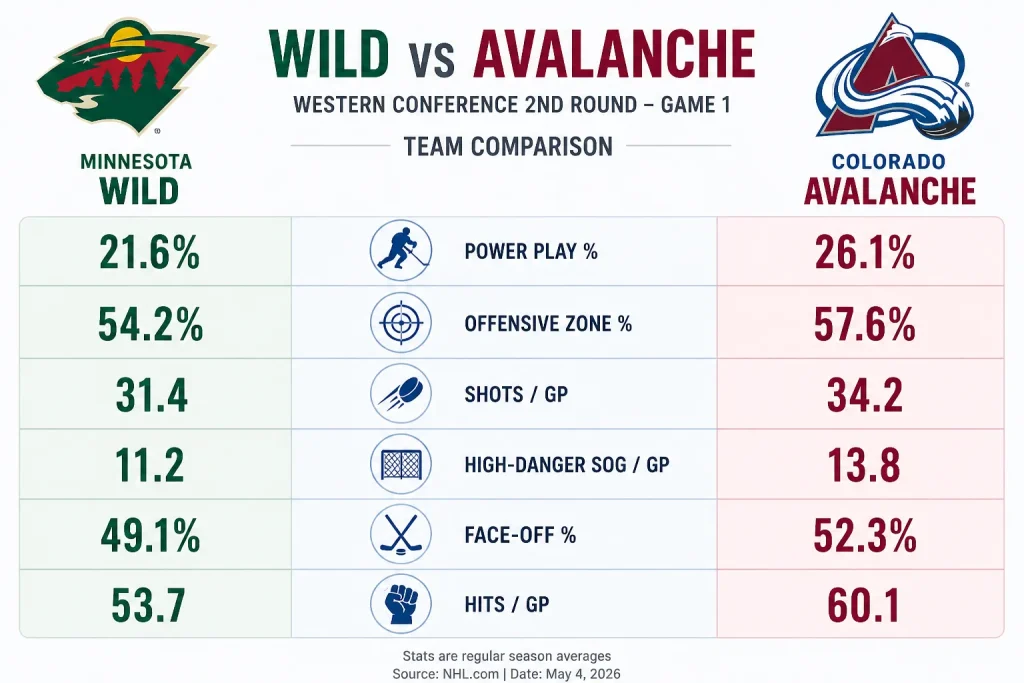
Physicality and defense pressure will test both teams
Minnesota’s physical game remains one of their biggest weapons. Marcus Foligno, Ryan Hartman, and Yakov Trenin play heavy hockey. They hit hard, pressure defenders, and make every shift uncomfortable.
Colorado responds differently. Their defense escapes pressure through movement. Cale Makar and Devon Toews move the puck quickly and avoid heavy forechecking by making smart passes. The physical edge belongs to Minnesota, but Colorado’s skating can neutralize that advantage.
The bigger issue for Minnesota is injuries. Jonas Brodin will miss Game 1, and Joel Eriksson Ek is unavailable for the opening games. That affects both defensive depth and faceoff strength.
Key players impact in wild vs avalanche Game 1
Nathan MacKinnon enters this game after a brilliant regular season with 53 goals and 74 assists. He remains Colorado’s most dangerous player because of his speed and ability to create space. Every playoff series changes when MacKinnon controls the puck.
Cale Makar remains the defensive star to watch. His ability to defend and attack makes him one of hockey’s most complete players. His matchup against Quinn Hughes is one of the most exciting individual battles in this series.
For Minnesota, Kirill Kaprizov remains the offensive engine. He led the Wild in assists during the first round and continues creating scoring chances through puck control and movement.
Matt Boldy has also been outstanding. He scored five even-strength goals against Dallas and continues to grow into a major playoff performer.
Goal scorers to watch in Game 1
Goal scoring usually comes from stars in playoff openers, and this game should be no different. MacKinnon leads Colorado with elite finishing ability, while Lehkonen remains one of their smartest net-front scorers. Nazem Kadri also remains important because he can score in tough areas and create second-chance opportunities.
For Minnesota, Kaprizov is the biggest scoring threat. His release remains elite, and he creates chances even in tight defensive coverage. Boldy adds another finishing option, while Mats Zuccarello can create dangerous setups around the net.
Both teams have scoring depth, but Colorado’s scoring layers look deeper.
Playmakers will create the game’s biggest moments
Playmakers matter more in playoff hockey because scoring chances are fewer. Martin Necas gives Colorado speed and vision, while MacKinnon drives the offense through controlled zone entries.
Makar also acts like a playmaker from the blue line. His passing opens shooting lanes.
For Minnesota, Kaprizov creates offense through patience and deception. Quinn Hughes adds playmaking from defense, and Zuccarello remains one of the smartest passers on the roster.
The team with cleaner puck movement will create better scoring chances.
Defensive leaders could quietly decide the result
Defense often decides playoff hockey even when goals get attention. Colorado’s top defensive pairing of Makar and Toews gives them balance. They can defend speed and still join the rush.
Minnesota’s Brock Faber and Jared Spurgeon carry major responsibility, especially with Brodin unavailable. They must handle Colorado’s top line and limit clean zone entries.
This defensive battle may not grab headlines, but it could define the result.
Momentum swings
Momentum is the hidden factor in playoff hockey. It changes quickly and often starts with simple moments. A big save changes confidence. A penalty kill changes energy. A power-play goal changes control.
If Wallstedt makes early saves, Minnesota gains belief. If Wedgewood stays sharp, Colorado’s confidence grows.
If Colorado scores first on the power play, Ball Arena becomes louder and harder for Minnesota. If Minnesota survives early pressure, the emotional balance shifts.
Momentum is not random. It follows execution.
That is why Game 1 feels so important.
Conclusion
The wild vs avalanche second-round opener brings everything playoff hockey should have: star power, speed, physicality, and tactical pressure. Colorado enters with the stronger record, more rest, and home ice, but Minnesota enters with belief after a hard-earned first-round victory.
MacKinnon, Makar, and Wedgewood give Colorado a powerful core. Kaprizov, Boldy, and Wallstedt give Minnesota enough firepower to challenge.
Game 1 is not just about the scoreboard. It is about setting control, building confidence, and taking the emotional edge into the series.
And in playoff hockey, the team that controls momentum often controls everything.
FAQs
Both teams finished the regular-season series at 2-1-1.
Nathan MacKinnon, Cale Makar, Kirill Kaprizov, and Matt Boldy are the main stars to watch.
Jesper Wallstedt is expected for Minnesota, while Scott Wedgewood is expected for Colorado.
Disclaimer:
The content shared by Meyka AI PTY LTD is solely for research and informational purposes. Meyka is not a financial advisory service, and the information provided should not be considered investment or trading advice.