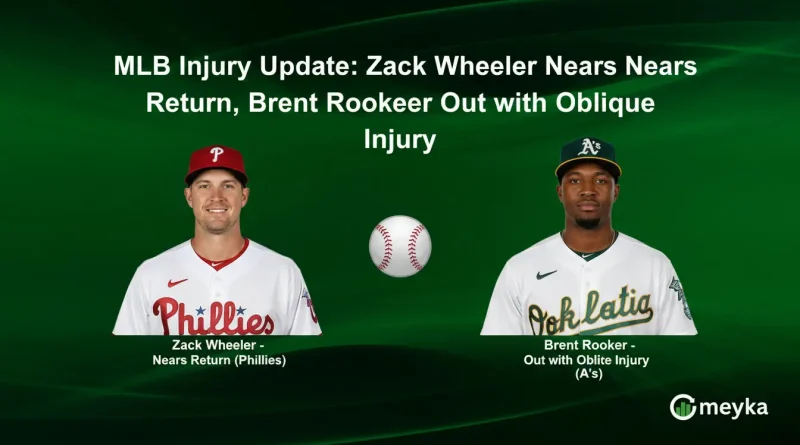
MLB Injury Update: Zack Wheeler Nears Return, Brent Rooker Out with Oblique Injury
The latest MLB Injury report arrives at a crucial moment in the season, and it carries two contrasting storylines that are already reshaping team dynamics. On one side, Philadelphia Phillies ace Zack Wheeler is closing in on a return that could redefine their rotation stability. On the other hand, Oakland Athletics slugger Brent Rooker has been sidelined with a right oblique strain, removing one of their most consistent power sources.
This is not just roster news. It is momentum news. It is about run prevention, offensive identity, and how injuries quietly tilt competitive balance across the league.
Zack Wheeler Injury Return Timeline: Phillies Regain Their Ace
Zack Wheeler’s recovery is trending in a positive direction after his extended absence due to upper-body-related issues and structured rehab progression. Reports confirm he has been advancing through bullpen sessions and controlled throwing programs, placing him on the verge of activation.
Before the injury, Wheeler remained one of MLB’s most dominant starting pitchers, consistently producing elite peripherals:
- ERA range: around mid-3.00s across recent seasons
- Strikeout rate: above league average (elite swing-and-miss profile)
- Innings workload: routinely 180+ inning-caliber ace production in peak years
Tactical moment: Rotation stabilization for Philadelphia
Without Wheeler, the Phillies were forced to redistribute high-leverage innings across Aaron Nola and Ranger Suárez. That created bullpen compression in late-game scenarios, reducing flexibility in matchups.
His return restores a classic ace structure:
- Deep starts reduce bullpen exposure
- Higher strikeout efficiency stabilizes high-pressure innings
- Matchup control in divisional series improves run prevention profile
Player impact insight
Wheeler’s fastball/slider sequencing continues to suppress hard contact, especially in high-leverage counts. Opposing lineups have struggled to sustain quality contact against him, particularly with runners in scoring position.
Supporting context
MLB injury tracking confirms Wheeler is “on the verge of season return” following rehab progression phases.
Brent Rooker Oblique Injury: Power Loss Hits Athletics Lineup
Brent Rooker’s right oblique strain is a significant setback for an Athletics offense built around limited power depth. Oblique injuries are particularly disruptive for hitters because they directly affect rotational torque and swing velocity.
Rooker has been one of Oakland’s primary run-producing bats, combining power and consistency in the middle order.
Offensive production profile (pre-injury baseline)
- Home run output: 30+ HR potential over full workload seasons
- RBI impact: primary middle-order run driver
- Slugging influence: key extra-base hit contributor
Tactical breakdown: What does Oakland lose?
- Primary power threat in high-leverage innings
- Protection for younger hitters in the lineup
- Late-game comeback probability via extra-base hits
Without Rooker, opposing pitchers can attack the strike zone more aggressively, reducing walk pressure and home run risk in the middle innings.
Unique insight: Lineup compression effect
The Athletics now shift toward contact-heavy sequencing, which lowers volatility but also caps offensive ceiling. This often leads to lower “explosive inning probability,” especially against playoff-caliber pitching.
Supporting data
- Rooker placed on 10-day IL with oblique strain (April 10, 2026)
- Recovery timelines for similar oblique injuries typically span multiple weeks
Statistical Snapshot: Impact Metrics That Define Both Absences
Even without a direct head-to-head matchup, the statistical contrast highlights the scale of impact.
Pitching vs batting influence indicators
- Wheeler (pitching control profile):
- Low opponent batting average allowed in recent seasons
- Strong strikeout-to-walk efficiency
- High innings durability ceiling
- Rooker (offensive output profile):
- Elite-level slugging potential in Oakland lineup context
- Primary source of extra-base hits
- High RBI dependency hitter in clutch situations
Game-state implications
- Phillies without Wheeler: increased bullpen usage, higher opponent scoring probability in the middle innings
- Athletics without Rooker: reduced multi-run inning probability and lower late-game comeback potential
League-wide context insight
Across MLB, oblique injuries remain one of the most frequent soft-tissue disruptions affecting hitters due to rotational load demands during swings.
Broader MLB Injury Context: Why These Updates Matter
The MLB Injury landscape continues to shape competitive balance early in the season. Pitching injuries often impact run prevention systems, while offensive injuries directly suppress scoring ceilings.
Commentators around the league have emphasized a growing trend: teams with deeper pitching depth recover faster from ace-level absences, while teams lacking power redundancy struggle to compensate for middle-order losses.
In Wheeler’s case, Philadelphia regains structural pitching dominance. In Rooker’s case, Oakland absorbs a measurable offensive downgrade that cannot be easily replaced internally.
One Return Restores Control, One Injury Removes Power
The MLB Injury narrative this week presents a clear contrast. Zack Wheeler’s nearing return strengthens a Phillies rotation built for postseason stability and late-game control. Brent Rooker’s oblique strain, however, strips the Athletics of their most reliable power threat.
In a league defined by thin margins, these injuries matter beyond individual availability. They alter game scripts, bullpen usage, and scoring probability. As the season develops, both cases reinforce a central truth of baseball: availability is not just an advantage. It is a competitive identity.
Disclaimer: The content shared by Meyka AI PTY LTD is solely for research and informational purposes. Meyka is not a financial advisory service, and the information provided should not be considered investment or trading advice.