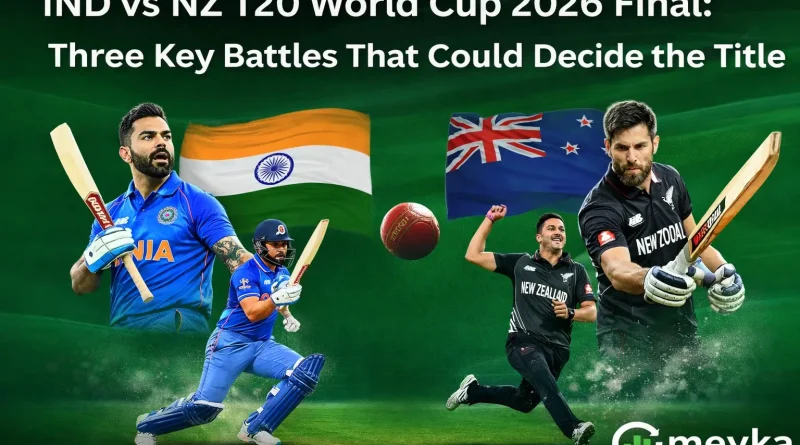
IND vs NZ T20 World Cup 2026 Final: Three Key Battles That Could Decide the Title
The IND vs NZ clash in the ICC Men’s T20 World Cup 2026 Final promises elite cricket and high-pressure moments. India and New Zealand meet on Sunday, March 8, 2026, at the Narendra Modi Stadium in Ahmedabad, the world’s largest cricket venue with a capacity of about 132,000 spectators. Both teams arrive after dominant semi-final performances earlier this week.
India defeated England by 7 runs in a thrilling semi-final in Mumbai, while New Zealand crushed South Africa by 9 wickets on Wednesday, March 4, 2026, in Kolkata. Momentum favors both sides for different reasons. India’s batting lineup delivered under pressure, while New Zealand produced one of the most explosive innings in tournament history.
The IND vs NZ final carries historic stakes for India. A victory would make them the first host nation to win the Men’s T20 World Cup, the first team to defend the title, and the first side to claim three trophies in the tournament’s history.
Jasprit Bumrah vs Finn Allen: Pace vs Explosive Power
A Record-Breaking Start from Allen
The IND vs NZ final will likely begin with a high-stakes duel between Jasprit Bumrah and Finn Allen. The New Zealand opener stunned the cricket world in the semi-final against South Africa. He smashed a century in just 33 balls, the fastest hundred in T20 World Cup history.
Allen’s innings included 8 sixes and 10 fours, setting the tone for New Zealand’s 9-wicket victory. His aggressive approach challenges any bowling attack during the powerplay overs.
Bumrah’s Control in High-Pressure Games
Bumrah remains India’s most reliable fast bowler in pressure situations. His ability to hit consistent yorkers and vary pace makes him dangerous early in innings. If Bumrah removes Allen inside the first six powerplay overs, India can slow New Zealand’s scoring rate significantly.
Sanju Samson vs Matt Henry: Momentum vs Early Breakthrough
Samson’s Match-Winning Semi-Final Knock
India’s batting depth shone during the semi-final victory over England. Sanju Samson, now 31 years old, delivered a crucial 89 runs under immense pressure. His innings anchored India’s total and helped secure the 7-run victory in Mumbai.
Samson’s ability to rotate strike and accelerate late has made him one of India’s key middle-order players in this tournament.
Henry’s New-Ball Threat
New Zealand will rely on Matt Henry to disrupt India’s rhythm early. Henry has built a reputation for seam movement and disciplined lengths. His strategy will target Samson before the batter settles into his rhythm.
If Henry strikes early, New Zealand can expose India’s middle order sooner than planned. Detailed bowling performance data remains available through espncricinfo.com, which tracks Henry’s economy and wicket-taking patterns across international tournaments.
Suryakumar Yadav vs Mitchell Santner: Captaincy Under Pressure
Leadership Styles in the IND vs NZ Final
The IND vs NZ showdown also features a fascinating tactical contest between captains Suryakumar Yadav and Mitchell Santner. Both leaders bring contrasting personalities and strategies to the final.
Yadav prefers aggressive field placements and attacking batting approaches. Santner relies on calm decision-making and disciplined bowling rotations.
Strategic Spin and Middle-Overs Control
Santner’s left-arm spin becomes critical during the middle overs. He aims to restrict scoring between overs 7 and 15, when teams often accelerate. Meanwhile, Yadav must manage India’s bowling rotations effectively against New Zealand’s explosive lineup.
Leadership decisions during these phases could determine which team controls momentum in the IND vs NZ final.
Key Semi-Final Performances
| Team | Opponent | Result | Key Performance |
|---|---|---|---|
| India | England | Won by 7 runs | Sanju Samson scored 89 |
| New Zealand | South Africa | Won by 9 wickets | Finn Allen 100 off 33 balls |
Three Factors That Could Decide the Final
Several match elements will shape the outcome of the IND vs NZ final in Ahmedabad.
- Powerplay wickets: Early breakthroughs could limit scoring momentum for either side.
- Middle-over control: Spin and disciplined bowling between overs 7–15 will shape the chase or defense.
- Captaincy decisions: Tactical calls from Yadav and Santner may influence key moments late in the match.