
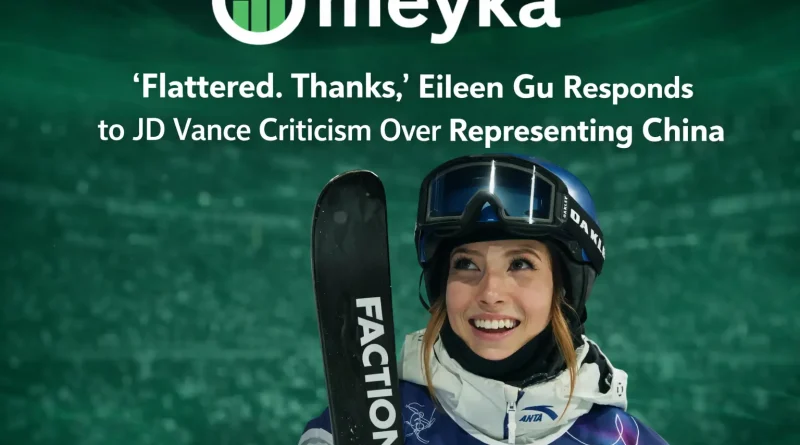
‘Flattered. Thanks,’ Eileen Gu Responds to JD Vance Criticism Over Representing China
Eileen Gu stands at the center of a high-profile sports and culture debate at the 2026 Winter Olympics in Milano-Cortina. Born on September 3, 2003, in San Francisco, she competes for China internationally after switching allegiance from the US in 2019. Gu is the most decorated female freestyle skier in Olympic history, with five Olympic medals, including two golds and three silvers.
US Vice President JD Vance publicly stated he wished American-born athletes like Gu would represent the United States, igniting debate across media and politics. His remarks specifically referenced how athletes benefited from US systems yet opted to compete for other nations, which touched off intense reactions online.
Gu’s response was swift and lighthearted. She called Vance’s suggestion “flattering” and reframed the discussion around her dual heritage and commitment to the sport. Her stance emphasizes athletic ambition over politics amid an Olympics already charged with global tensions.
Who Is Eileen Gu?
Eileen Gu is a freestyle skier specializing in halfpipe, slopestyle, and big air. Born in San Francisco, she competed for the US early in her career before formally switching to China in June 2019.
| Attribute | Detail |
|---|---|
| Birth | September 3, 2003 |
| Birthplace | San Francisco, CA, USA |
| Representing | China (since 2019) |
| Olympic Medals | 5 total (2 gold, 3 silver) |
| Major Events | 2022 Beijing Olympics, 2026 Milano-Cortina Olympics |
| Education | Stanford University |
Gu’s decision to represent China was driven by her desire to contact more young athletes and grow winter sports globally. She also speaks fluent Mandarin and identifies with both her American and Chinese roots.
Her medal success includes becoming the youngest Olympic champion in freestyle skiing at age 18 in 2022 and repeating podium performances in 2026. This sporting excellence underpins much of the current media scrutiny.
What JD Vance Said and Why It Matters
US Vice President JD Vance’s comments struck a political chord. Speaking in the context of the 2026 Winter Olympics, Vance said that athletes who grew up and benefited from the US system should compete for the United States.
His remarks linked national identity with athletic representation, suggesting that competing for other countries detracts from American national pride. Some supporters agreed, while critics called the stance overly political for a sporting event.
This debate matters because Olympic athletes often hold influence beyond sports, especially in global contexts where personal narratives intersect with geopolitics. Gu’s situation highlights how modern athletes navigate both identity and competition on the world stage.
Eileen Gu’s Response: “Flattered. Thanks, JD.”
Gu’s answer to Vance was measured and nuanced. She described his comment as “sweet” and said she was flattered that he wanted her to represent the US without endorsing his political perspective.
Gu reaffirmed she’s proud of her dual heritage and that her choice was about inspiration and personal goals, not political statements. This response reframes the discourse around her athletic mission, rather than nationality disputes.
Her approach also shifted attention back to competition: Gu continues to focus on her performance in freeski events and chases further Olympic success. This message keeps the narrative on sport, not controversy.
Broader Context: Sport, Nation, and Identity
Athletes representing countries other than their birthplace is not uncommon. However, reactions differ based on geopolitical climates and public perceptions. In Gu’s case, intense focus stems in part from global tensions related to China and America.
Unlike some dual-national athletes who switch representation quietly, Gu’s high profile, including media appearances and endorsement deals, amplifies each media cycle. Her situation exemplifies how modern sport intersects with cultural identity debates.
Bottom Line
Eileen Gu’s reply to JD Vance’s criticism is more than a headline; it’s a strategic statement in a charged Olympic moment. By saying she is “flattered” and doubling down on her mission to inspire, she reframed national debate into athletic purpose. Her stance offers a lesson for sports leaders and fans alike: in an era of global competition, diversity and dual identity can enrich rather than dilute the spirit of the Olympics.
Disclaimer: The content shared by Meyka AI PTY LTD is solely for research and informational purposes. Meyka is not a financial advisory service, and the information provided should not be considered investment or trading advice.