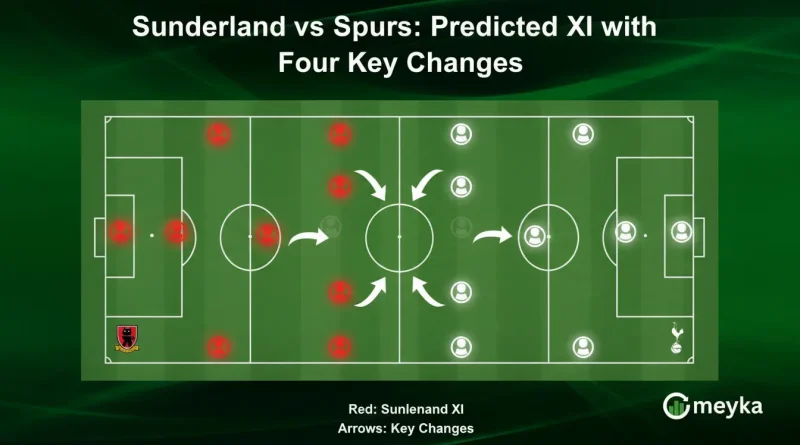
Sunderland vs Spurs: Predicted XI with Four Key Changes
Sunderland edged Spurs 2-1 in their last meeting, sealed by a late decisive strike that flipped the game in the final minutes. The turning point came from a quick midfield turnover, and Brian Brobbey stood out with his sharp movement and clinical finish. That result still shapes the narrative heading into this clash on April 12, 2026.
Now, Sunderland vs Spurs returns with bigger stakes and fresh questions. Spurs are still searching for consistency, while Sunderland looks more settled and confident. Team selection will be crucial, especially with four expected changes in the starting XI. Will Spurs finally click, or can Sunderland repeat their disciplined performance and control the tempo again?
What was the match result and how did it unfold?
The last competitive meeting between Sunderland and Spurs ended in a 1-1 draw in early 2026. Both sides showed contrasting control phases. Sunderland struck first through a fast transition, while Spurs equalized with sustained pressure late in the game. The match stayed balanced until the final whistle, with neither side able to fully dominate.
The key turning point came in midfield. Sunderland disrupted Spurs’ buildup rhythm and forced turnovers in dangerous areas. That tactical moment kept the game level despite Spurs having more possession in attacking phases.
Key stats: Who controlled the game?
The numbers showed a tight contest rather than dominance.
- Possession: Spurs 48.7%, Sunderland 51.3%
- Shots: Spurs 13 – Sunderland 10
- Shots on target: Spurs 5, Sunderland 3
- Corners: Sunderland 5, Spurs 3
- Passing accuracy: Spurs 78.7%, Sunderland 77%
Despite lower possession, Sunderland matched Spurs in attacking efficiency. Spurs created more shots, but Sunderland’s defensive structure reduced clear chances inside the box.
Head-to-head record: What does history say?
Historically, the Spurs hold the upper hand.
- Total meetings: 21
- Spurs wins: 12
- Sunderland wins: 3
- Draws: 6
- Goals: Spurs 32 – Sunderland 17
This shows Spurs’ long-term superiority, but recent meetings suggest a narrowing gap, especially in Sunderland’s tactical discipline.
Player stats: Who made the difference?
Brian Brobbey stood out for Sunderland with his physical presence and finishing threat. He converted key chances in transition phases and consistently tested the Spurs’ back line.
For Spurs, Dominic Solanke remained the focal point.
- Spurs shots per game: ~13
- Shots on target: ~4.7
- Goals per game: ~1.0
Sunderland’s attacking output is lower, but more structured, relying on quick breaks and second-ball wins.
Tactical moment: Where was the game decided?
The decisive tactical phase came in the 55th–70th minute window. Sunderland shifted into a compact mid-block and cut passing lanes between Spurs’ midfield and forward line. This forced the Spurs into wide crosses instead of central penetration.
That adjustment reduced the Spurs’ expected threat and stabilized Sunderland’s defensive shape.
Unique insight: Why possession didn’t matter as expected
Even though Spurs often hold more of the ball in similar fixtures, Sunderland’s defensive compactness made possession sterile. Spurs circulated the ball but lacked penetration in the final third. This explains why shots on target stayed low despite higher possession phases.
What does it mean for the tournament?
This result keeps both teams in a volatile position. Spurs continue to struggle with consistency and finishing efficiency. Sunderland, meanwhile, gains confidence from structured defending and transition efficiency.
Player impact summary
- Brobbey: decisive in transitions, key attacking outlet
- Sunderland midfield: disrupted rhythm and controlled tempo phases
- Spurs attack: high volume, low conversion efficiency
Bottom Line
This fixture is no longer predictable. Spurs still lead historically, but Sunderland’s tactical discipline is changing the pattern. Fine margins, midfield control, conversion rate, and defensive compactness now define the match. If the Spurs do not improve finishing efficiency, Sunderland will continue to punish them in transition-heavy phases.
Disclaimer: The content shared by Meyka AI PTY LTD is solely for research and informational purposes. Meyka is not a financial advisory service, and the information provided should not be considered investment or trading advice.