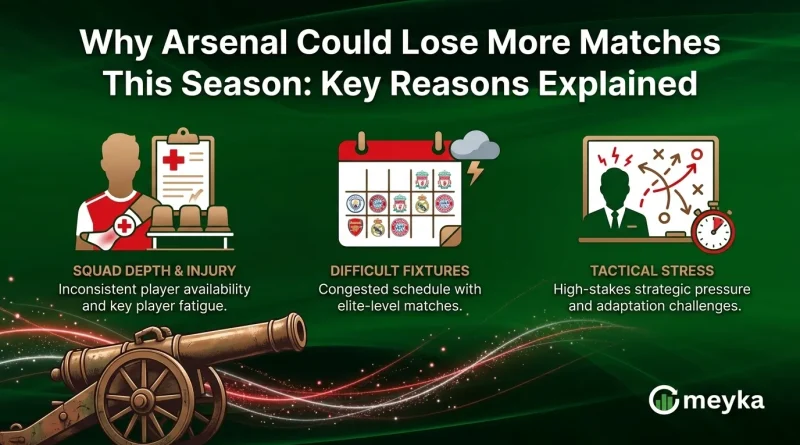
Why Arsenal Could Lose More Matches This Season: Key Reasons Explained
Arsenal’s 2–0 defeat to Manchester City on 22 March 2026 sent a clear message. The decisive moment came early in the second half when City struck on the counter. Kevin De Bruyne controlled the tempo, while Erling Haaland’s sharp movement exposed Arsenal’s back line. It wasn’t just a loss; it was a warning sign.
Despite strong possession numbers and consistent results this season, Arsenal are starting to show cracks in key moments. Their attacking play looks fluid, but not always effective under pressure. Big games are exposing gaps in decision-making and finishing. As the title race tightens, these small issues could turn costly. The question now is simple: are Arsenal running out of answers at the worst possible time?
Tactical Predictability Is Starting to Hurt Arsenal
Why are teams finding it easier to defend against?
Arsenal still dominates the ball. But control is not the same as threat. Their 58.0% average possession in the Premier League shows authority, yet penetration remains inconsistent.
- Shots per match: 14.33
- Shots on target: ~5.0 per game
- Conversion rate: 14%
Opponents now sit deep and force him wide.
Tactical moment:
In the Carabao Cup final (22 March 2026), City allowed them possession, then struck in transition. Arsenal had early control but no cutting edge.
Lack of Clinical Edge in Key Moments
Are Arsenal wasting too many chances?
The numbers say yes. Their averages 5.04 shots on target per game, but goals do not always follow.
- Goals (league): 46 in 24 matches
- xG: 43.61 → slight overperformance
- Shots per goal: 7.29
Player impact
- Gyökeres leads scoring but lacks consistency in big games
- Trossard contributes assists but not volume goals
Insight:
They create enough chances. But in tight matches, finishing becomes the difference between wins and losses.
Mental Fragility in High-Stakes Matches
Do Arsenal struggle under pressure?
The Carabao Cup final result highlights a familiar issue.
Match result: Arsenal 0–2 Man City (22 March 2026)
- Goals: Nico O’Reilly (2)
- They dominated the early phases
- Failed to respond after conceding
What changed during the game?
Tactical moment:
Between minutes 50–65, City raised the intensity and scored twice. They lost structure and composure.
Technical analysis summary:
When momentum shifts, they struggle to regain control. That is a pattern.
Squad Depth and Injury Sensitivity
Is the squad strong enough for a title run?
Depth remains a concern.
- Heavy reliance on key players like Declan Rice
- Limited rotation quality in attack
- Goalkeeping errors proved costly in big matches
Player impact
Rice drives midfield transitions. Without him, tempo drops.
Insight:
A long season exposes thin squads. Arsenal may feel that pressure late.
Tactical Rigidity vs Elite Opposition
Why do top teams expose Arsenal?
Against elite sides, Arsenal’s structure becomes predictable.
Head-to-head example:
- Arsenal vs Man City (Final): 0–2 loss
- City exploited the space behind midfield
Key stats from recent matches
- Possession: 51–60%
- Shots on target: often under 5 in tight games
Highlights:
Arsenal creates volume. Opponents create better chances.
Why More Losses Could Be Coming?
Arsenal are still strong. The table proves it. But performances tell a deeper story. They dominate possession. They create chances. Yet they struggle in decisive moments. Tactical rigidity, finishing issues, and pressure in big games remain concerns.
What does it mean for the season?
If these patterns continue, Arsenal could drop points in crucial fixtures. And in a tight title race, that could be the difference between lifting the trophy and falling short.
Disclaimer: The content shared by Meyka AI PTY LTD is solely for research and informational purposes. Meyka is not a financial advisory service, and the information provided should not be considered investment or trading advice.