
ICC Blames Gulf Crisis for Delay in Teams Returning After T20 World Cup
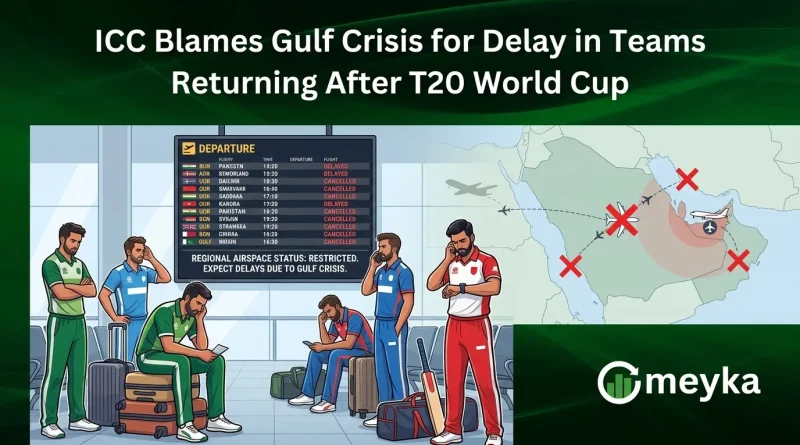
Travel disruptions after the ICC Men’s T20 World Cup have delayed several teams returning home. The International Cricket Council (ICC) says the crisis in the Gulf region caused major airspace closures. Officials insist that safety remains the top priority for all players and staff.
Gulf Crisis Delay T20 World Cup Team Travel
The ICC Men’s T20 World Cup faced unexpected travel challenges after escalating tensions in West Asia disrupted international flights. Airspace closures across key Gulf transit hubs forced airlines to cancel or reroute several scheduled flights. As a result, teams that had completed their campaigns remained stranded in India.
The ICC explained that the crisis caused widespread aviation disruption. Missile warnings, route restrictions, and sudden airspace shutdowns created logistical problems for both commercial and charter flights. Officials stressed that these circumstances were outside the organization’s control.
Because of these complications, the governing body had to design alternate travel routes. Each arrangement required approval from aviation authorities and airlines, which significantly slowed the process.
T20 World Cup Teams Were Affected
Several teams participating in the ICC Men’s T20 World Cup experienced travel delays. Players from the West Indies cricket team, South Africa national cricket team, and Zimbabwe national cricket team remained in India after their elimination from the tournament.
According to the ICC, nine West Indies players already departed while the remaining members were scheduled on commercial flights within the following 24 hours. The South African squad also began leaving India, with the full contingent expected to depart within 36 hours.
Zimbabwe Cricket confirmed that its players were safe but unable to travel due to the evolving situation in the Middle East. Their original flight route through Dubai became unavailable because major transit hubs faced cancellations and operational restrictions.
ICC Respond to Criticism Over Travel Arrangements
The ICC rejected claims that some teams received preferential treatment during the ICC Men’s T20 World Cup travel arrangements. Critics questioned why the England cricket team managed to leave India earlier than other teams.
Former England captain Michael Vaughan and several players raised concerns publicly. However, the ICC insisted that departure timing depended solely on route availability, aircraft permissions, and safety conditions.
Officials clarified that England traveled via Egypt because that route remained unaffected by airspace restrictions. Meanwhile, teams planning to fly through Gulf transit hubs faced significant disruptions. The governing body emphasized that every decision prioritized the safety and welfare of players, staff, and their families.
Conclusion
The travel delays following the ICC Men’s T20 World Cup highlight how global conflicts can disrupt international sporting events. Airspace closures across the Gulf region created complex logistical challenges for teams trying to leave India. Despite criticism, the ICC maintains that safety considerations remain the primary factor guiding all travel arrangements.
FAQs
Airspace closures and flight disruptions in the Gulf region caused travel delays.
West Indies, South Africa, and Zimbabwe teams faced travel disruptions.
England traveled through an unaffected route via Egypt.
Disclaimer:
The content shared by Meyka AI PTY LTD is solely for research and informational purposes. Meyka is not a financial advisory service, and the information provided should not be considered investment or trading advice.